

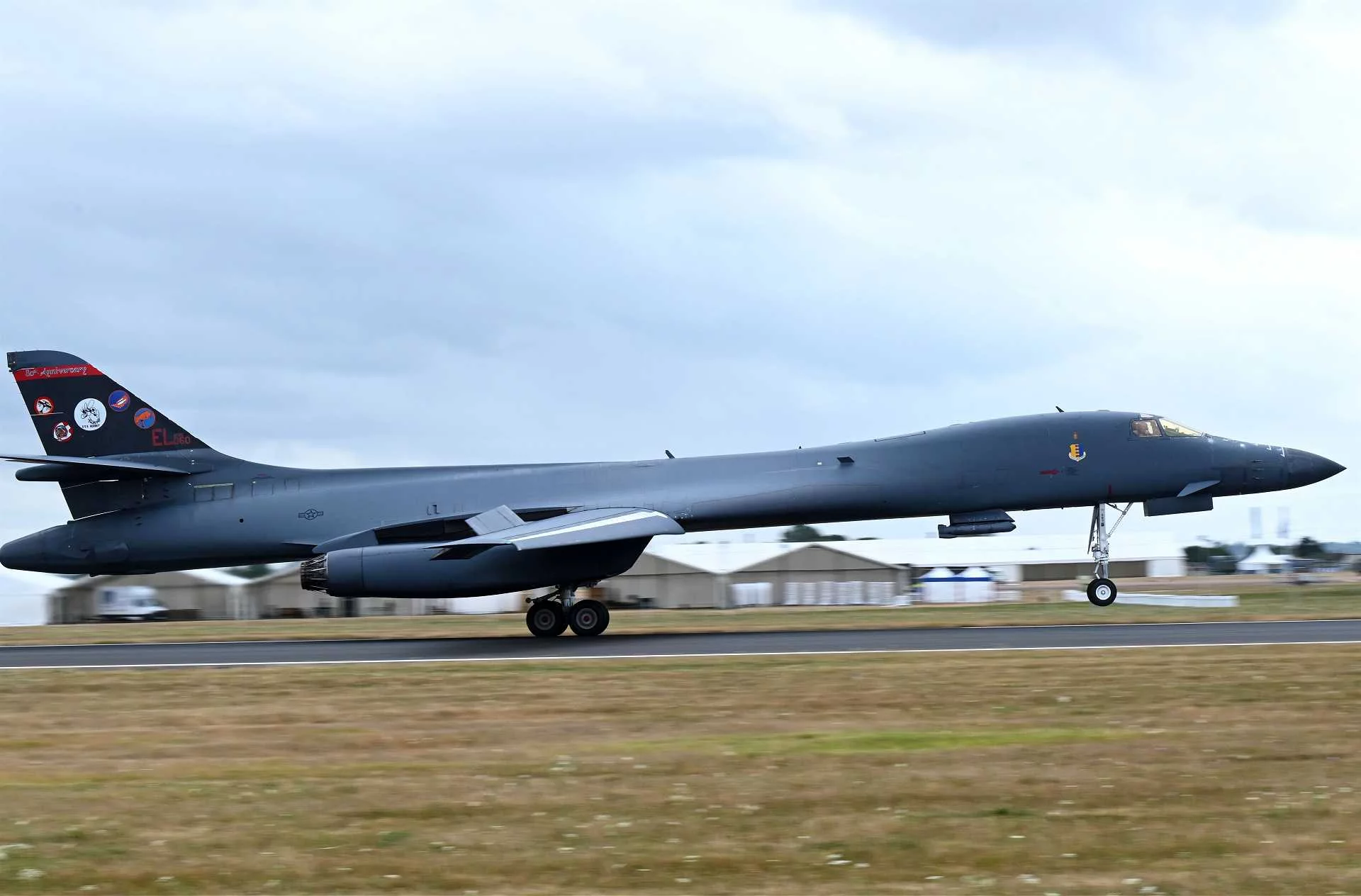
A U.S. Air Force B-1B Lancer strategic bomber from the 37th Bomb Squadron at Ellsworth Air Force Base, South Dakota, touched down at RAF Fairford, England, on July 15, 2025, ahead of the Royal International Air Tattoo (RIAT) event held from July 18 to 20. Showcased as a static display, the B-1B symbolizes the United States’ advanced long-range strike capabilities and underscores its vital role within NATO’s deterrence framework and transatlantic defense partnerships. Its rare public exhibition in Europe also sends a clear strategic message about U.S. airpower readiness.
The B-1B Lancer is a supersonic, long-range bomber engineered to deliver heavy payloads of conventional munitions across continents. Powered by four General Electric F101-GE-102 afterburning turbofan engines, it can cruise at speeds up to Mach 1.25 at altitude and fly over 7,400 kilometers without refueling—extendable via aerial refueling. Its variable-geometry wings allow for optimal aerodynamic performance during low-level penetration missions and high-speed cruising. The bomber can carry an impressive arsenal, including up to 24 AGM-158 Joint Air-to-Surface Standoff Missiles (JASSMs), 84 Mk-82 500-pound bombs, or a combination of guided and unguided weapons, offering unparalleled operational flexibility.
Designed for rapid reaction, theater-wide strikes, and deep interdiction in contested airspace, the B-1B’s blend of speed, reduced radar signature, and advanced survivability features enable it to evade sophisticated air defense systems and deliver precision strikes with minimal warning. Unlike its counterparts the B-52 and B-2, the B-1B is not restricted by nuclear payload limitations under international arms treaties, dedicating its capabilities entirely to conventional warfare. This makes it a cornerstone platform for conventional deterrence and power projection in high-intensity conflict scenarios. Its spacious weapons bay and integrated defensive avionics suite support both initial strikes and sustained air campaigns.
In Europe, the B-1B holds strategic value as part of the U.S. Bomber Task Force, frequently deploying to RAF Fairford and NATO bases to conduct missions across Northern Europe, the Baltic, Black Sea, and Eastern Europe. These deployments bolster interoperability with allied forces and showcase U.S. commitment to NATO deterrence efforts. Recent exercises such as Arctic Challenge, Point Blank, and Baltic Operations have featured the B-1B practicing maritime interdiction, precision strikes, and integration with fifth-generation fighters, serving as a visible deterrent against Russian military provocations along NATO’s eastern flank.
Operationally, the B-1B remains crucial in U.S. global military strategy. In 2024, it carried out long-range precision strikes against Iranian-backed militia targets in the Middle East, minimizing collateral damage while disrupting enemy command and logistics. In the Indo-Pacific, rotational deployments to Andersen Air Force Base, Guam, supported Bomber Assurance and Deterrence missions responding to Chinese military activity near Taiwan and the South China Sea. The bomber’s rapid global reach and precision strike capability ensure it remains a vital asset in evolving strategic environments demanding sustained long-range firepower.
By featuring the B-1B Lancer at RIAT 2025, the U.S. Air Force highlights its enduring commitment to European security and NATO solidarity, while giving defense communities a rare opportunity to observe one of its most capable and versatile aircraft. As NATO confronts increasingly complex security challenges, the B-1B’s strategic presence serves as a testament to allied readiness and the strength of transatlantic defense partnerships.
