

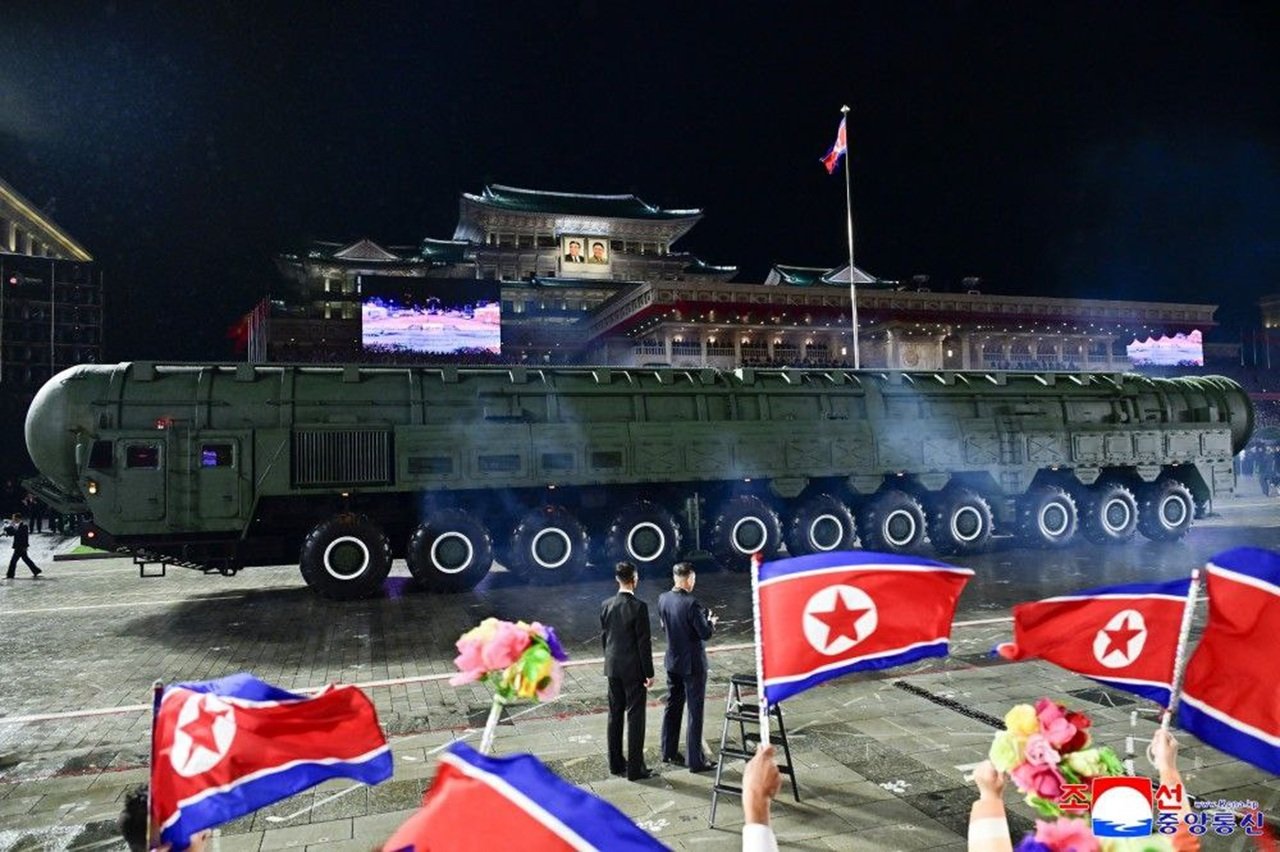
South Korea’s top military commander, Gen. Jin Yong-sung, has voiced concern that Russia may have provided technical assistance in developing North Korea’s newly revealed Hwasong-20 intercontinental ballistic missile (ICBM).
Speaking during a parliamentary audit on Tuesday, Jin pointed to noticeable changes in the transporter erector launcher (TEL) design compared to earlier models, as well as intensifying military cooperation between Moscow and Pyongyang. These factors, he said, suggest a “strong possibility” of foreign involvement.
The Hwasong-20 made its public debut during a grand military parade in Pyongyang marking the 80th anniversary of the Workers’ Party of Korea. Alongside it, North Korea showcased a hypersonic missile and multi-launch platforms for attack drones, underscoring its ongoing effort to expand strike capabilities.
According to Jin, the modified TEL design of the Hwasong-20 differs significantly from that of the Hwasong-19, first tested in 2023 — a change that may point to outside engineering input.
Recent arms exchanges and high-level meetings between Russia and North Korea further fuel suspicions. Reports indicate that Pyongyang has sent artillery shells and ballistic missiles to Moscow to support Russia’s war effort in Ukraine.
Although North Korea has described the Hwasong-20 as “its most powerful nuclear strategic weapon system,” the missile’s true range and operational readiness remain unverified by independent sources.
Asked about the South’s ability to intercept North Korea’s new hypersonic missile, Jin admitted that defenses might “face minor difficulties” but insisted that interception “is still achievable.”
To strengthen its surveillance and early-warning capabilities, South Korea has been expanding its reconnaissance satellite network. Since launching its first spy satellite in December 2023, Seoul has placed four satellites in orbit and plans a fifth by the end of this year. Once complete, the constellation will allow the South to monitor North Korea roughly every two hours.
“It is crucial to collect information quickly and repeatedly through both military and civilian satellites,” Jin noted, emphasizing the importance of rapid intelligence gathering.
His remarks come amid growing alarm in Seoul and Washington over the strategic implications of renewed Russia–North Korea military cooperation, which appears to be yielding tangible technical and operational gains for both nations.
