

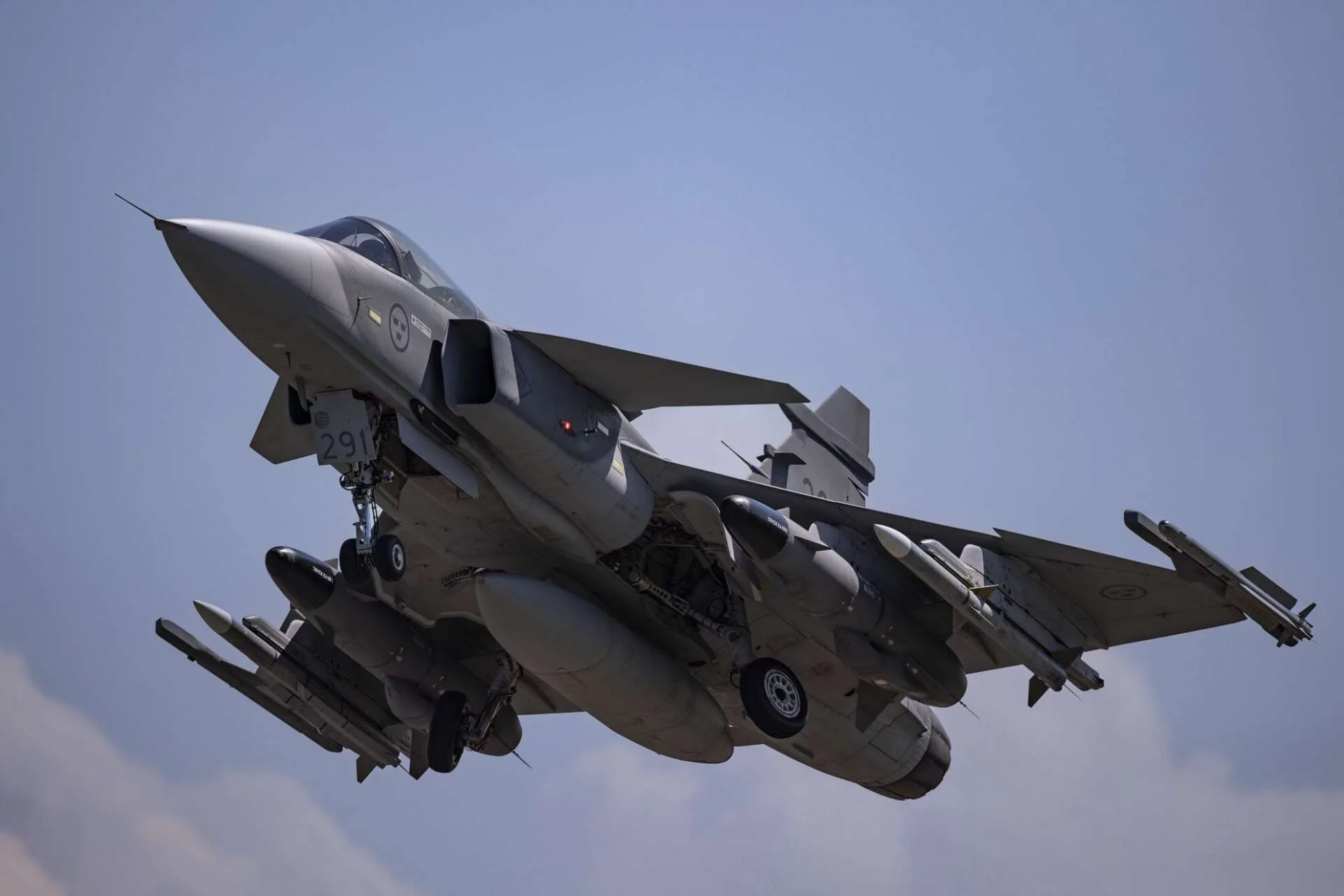
Sweden and Ukraine have signed a letter of intent (LOI) for Kyiv to acquire between 100 and 150 Saab JAS 39 Gripen E fighter jets — one of the largest prospective export deals in Sweden’s defense history. The agreement signals a major step toward building a postwar Ukrainian air force based on NATO-standard, cost-efficient, and rapidly deployable aircraft.
The announcement, made in Linköping by Swedish Prime Minister Ulf Kristersson and Ukrainian President Volodymyr Zelensky, outlines a framework for what could become a transformative defense partnership. The figures are unprecedented for a single customer, potentially doubling Sweden’s largest Gripen export to date and establishing a deep industrial and political bond between Stockholm and Kyiv.
According to Swedish broadcaster TV4, the LOI is non-binding but sets the stage for negotiations on configuration, financing, training, and phased deliveries. Officials indicated that even under current production capacity, first deliveries could take place within three years of a finalized contract — aligning the plan with Ukraine’s postwar force structure.
The Gripen E, equipped with advanced sensors, an AESA radar, a modern electronic warfare suite, and NATO-interoperable datalinks, is optimized for dispersed, high-performance operations from road bases and contested airspace. Sweden only began receiving its first Gripen E units this month, marking the type’s operational maturity for future export users.
For Ukraine, a fleet of 100 or more fighters represents a force-structure transformation — enabling continuous air policing, strike and SEAD/DEAD missions, and dedicated training squadrons. This scale would shift Ukraine from a patchwork capability to a sovereign, sustainable combat aviation model.
Gripen’s strengths — dispersed basing, quick turnaround, low operating costs, and rugged field maintenance — make it especially suited to nations facing missile and drone threats. Analysts say that while F-16s serve as an immediate solution, a Gripen E fleet would offer long-term advantages in automation, resilience, and cost-effectiveness, creating a balanced and sustainable airpower foundation.
Strategically, the deal deepens Sweden–Ukraine ties and reinforces NATO’s northern flank, signaling that Ukraine’s postwar air arm will be robust, interoperable, and enduring. At least 100 aircraft would enable credible defensive counter-air, standoff strike, and persistent ISR capabilities — positioning Ukraine as a fully integrated contributor to European collective defense.
Although no pricing details were disclosed, for reference, Brazil’s 36-aircraft Gripen E/F program signed in 2014 cost SEK 39.3 billion (about $5.4 billion) including development and support. A Ukrainian package of over 100 aircraft would therefore span several years, with investments in production, training, munitions, and local industrial participation.
If formalized, the agreement would mark a decisive leap for Ukraine — transforming its air force from fragmented fleets into a cohesive, NATO-compatible combat aviation system capable of deterring and defending in Europe’s increasingly contested skies.
