

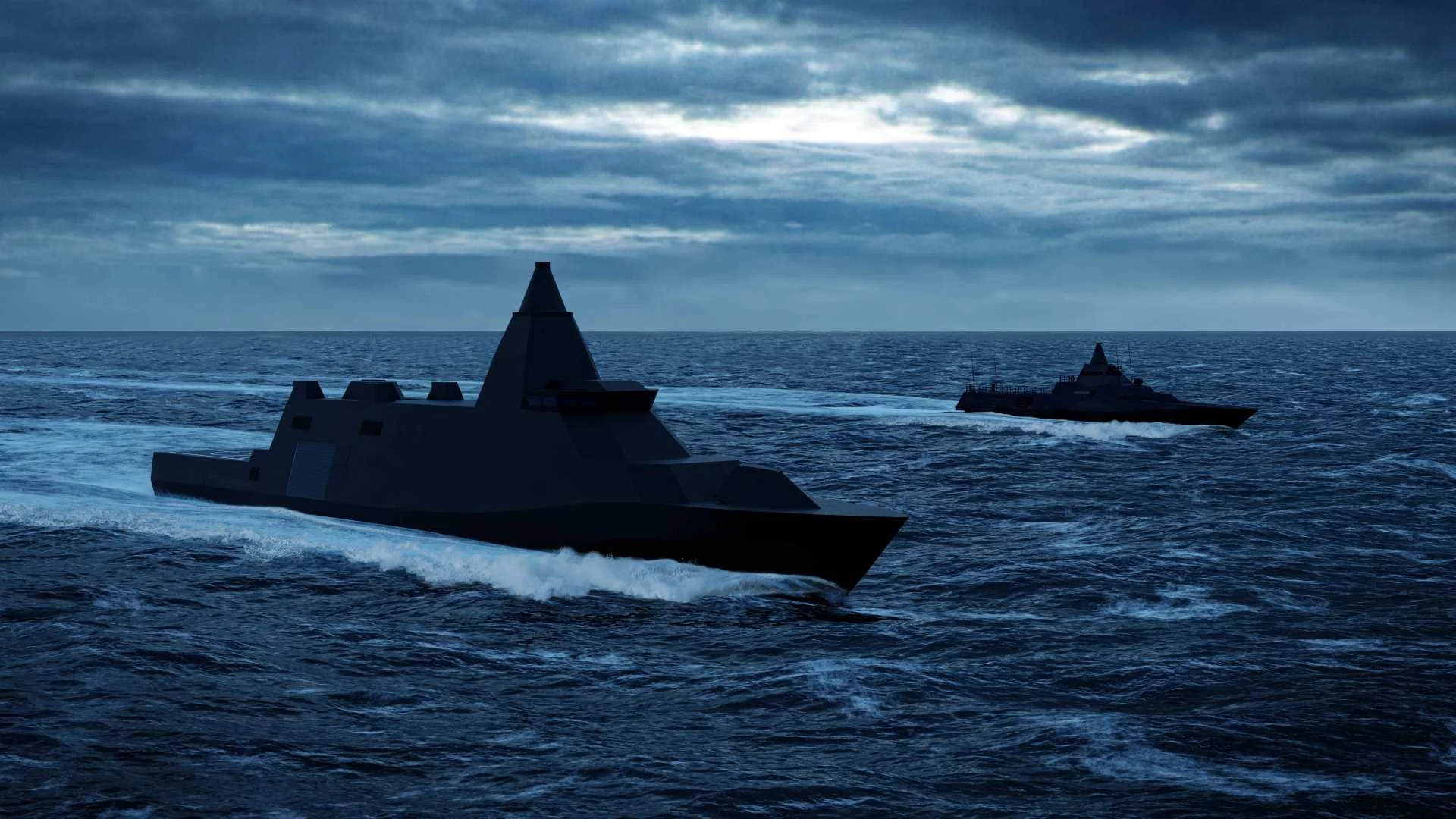
Sweden is preparing to announce its selection for the Luleå-class frigate program in early 2026, marking the country’s largest surface fleet expansion since the 1980s. Four major defense shipbuilders—Saab, Naval Group, Babcock, and Navantia—are competing for the contract.
Swedish Defence Minister Pål Jonson confirmed the timeline during a joint press conference with French Defence Minister Catherine Vautrin on November 24, 2025. The new frigates will be based on mature European designs and adapted to Sweden’s operational needs. Under the current plan, two of the ships will enter service by 2030, and another two by 2035, forming the backbone of Sweden’s next-generation surface fleet.
More Than 120 Meters, Up to 4,500 Tons: Sweden’s Largest Warships in Decades
The Luleå-class frigates are expected to measure over 120 meters in length with a displacement between 3,000 and 4,500 tonnes, significantly larger than the Göteborg and Visby-class corvettes currently in service.
This shift represents Sweden’s transition from a coastal defense doctrine to a more robust blue-water naval capability, a strategic necessity following Russia’s full-scale invasion of Ukraine.
France’s FDI-Class Proposal Gains Momentum
One of the leading contenders is France’s FDI (Frégate de Défense et d’Intervention) frigate, produced by Naval Group. French officials have emphasized their readiness to deliver a fully equipped vessel by 2030 and to expand industrial cooperation with Saab.
The lead French ship, Amiral Ronarc’h, entered service in 2025 and features a modern digital combat architecture, Aster 15/30 air-defense missiles, and the Thales Sea Fire AESA radar. France plans to send the ship to Sweden for demonstrations in early 2026.
International Competition: Saab, Babcock, and Navantia
Sweden is also evaluating offers from Saab, Babcock, and Navantia. Navantia’s portfolio includes a wide range of frigates, including the ASW-focused Bonifaz-class.
Stockholm is considering a hybrid production model where the hulls are built abroad and outfitted domestically—a method previously used for the intelligence ship Artemis.
Strategic Value for NATO Integration
Minister Jonson highlighted that the future frigates will play a critical role in air and missile defense for both Sweden and NATO operations.
With four Luleå-class frigates expected in service by 2035, Sweden is poised to field the most capable surface combatants in its modern naval history, reinforcing its role in Northern Europe’s security architecture.
