

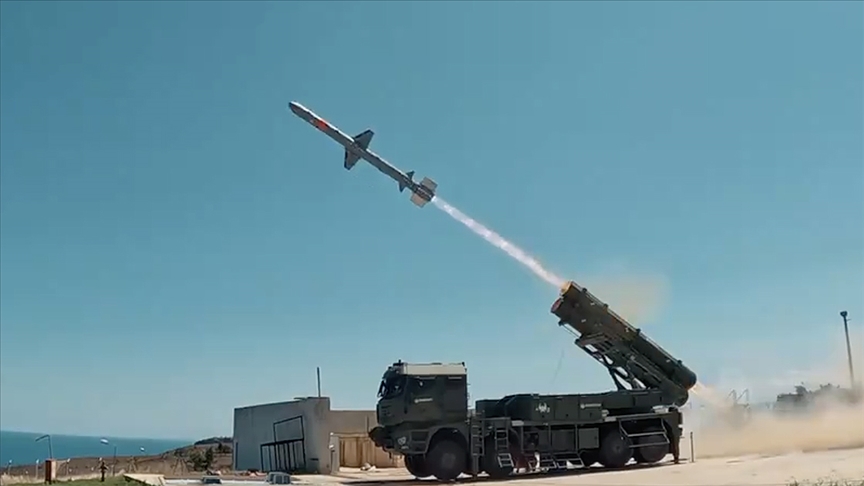
At the IDEF 2025 exhibition held in Istanbul, Türkiye’s defense industry introduced a significant innovation. Roketsan publicly unveiled a new land-based system capable of launching the Kara Atmaca cruise missile from a container platform for the first time. Designed to resemble a standard cargo container, the system emphasizes stealth and mobility. The launcher, which is extremely difficult to visually detect, can carry up to six Kara Atmaca missiles and be rapidly deployed to different locations when needed.
Unlike the naval version of the Atmaca missile, the Kara Atmaca has been specifically adapted for long-range, precision strikes against land-based targets. It is tailored for deep-strike operations on high-value fixed or mobile targets and engineered to operate independently in various terrains. While the naval version has been in active service with the Turkish Navy since 2021, the land-based Kara Atmaca has undergone unique engineering modifications optimized for ground operations.
According to Roketsan, the Kara Atmaca has a range exceeding 250 kilometers and is equipped with a 220-kilogram high-explosive fragmentation warhead. Its high subsonic speed and low radar cross-section help it evade early warning systems. The guidance system combines inertial navigation (INS), global navigation satellite systems (GNSS), radar altimeters, and terrain-referenced navigation. This enables the missile to fly at low altitudes along complex routes and achieve pinpoint accuracy even in GPS-denied environments. Furthermore, its datalink allows for in-flight mission updates or cancellation, providing operational flexibility and control.
The container-based design introduces a new operational concept distinct from traditional military platforms. The launcher, indistinguishable from a civilian freight container, can be transported via trucks, trains, or even civilian ships. Upon reaching the designated area, it can remain concealed until activated, enabling surprise strikes. This capability allows the system to be deployed near coastal areas, rail yards, or remote highways, significantly complicating enemy reconnaissance and countermeasures. Although reminiscent of Russia’s Club-K and China’s similar hidden missile systems, Türkiye’s version is designed with NATO interoperability, tactical flexibility, and logistical efficiency in mind.
This new launcher represents a major milestone in Türkiye’s Atmaca missile program, which began in the early 2010s. While the naval version of Atmaca has already been exported, the container-based Kara Atmaca variant is also expected to attract attention on the international market. Its mobility and concealability make it particularly appealing in regions where fixed missile batteries are vulnerable or politically sensitive.
The new variant of Kara Atmaca may serve as an effective deterrent in volatile regions such as the Eastern Mediterranean or near Türkiye’s borders. Its integration with civilian infrastructure allows for powerful and unexpected strikes from concealed positions, aligning directly with A2/AD (anti-access/area denial) strategies.
In conclusion, Roketsan’s containerized Kara Atmaca cruise missile system stands out as a next-generation solution combining stealth, mobility, and firepower. Designed to meet the demands of modern battlefields, it marks a notable shift in Türkiye’s defense capabilities and highlights the country’s evolving approach to strategic deterrence and operational adaptability.
