

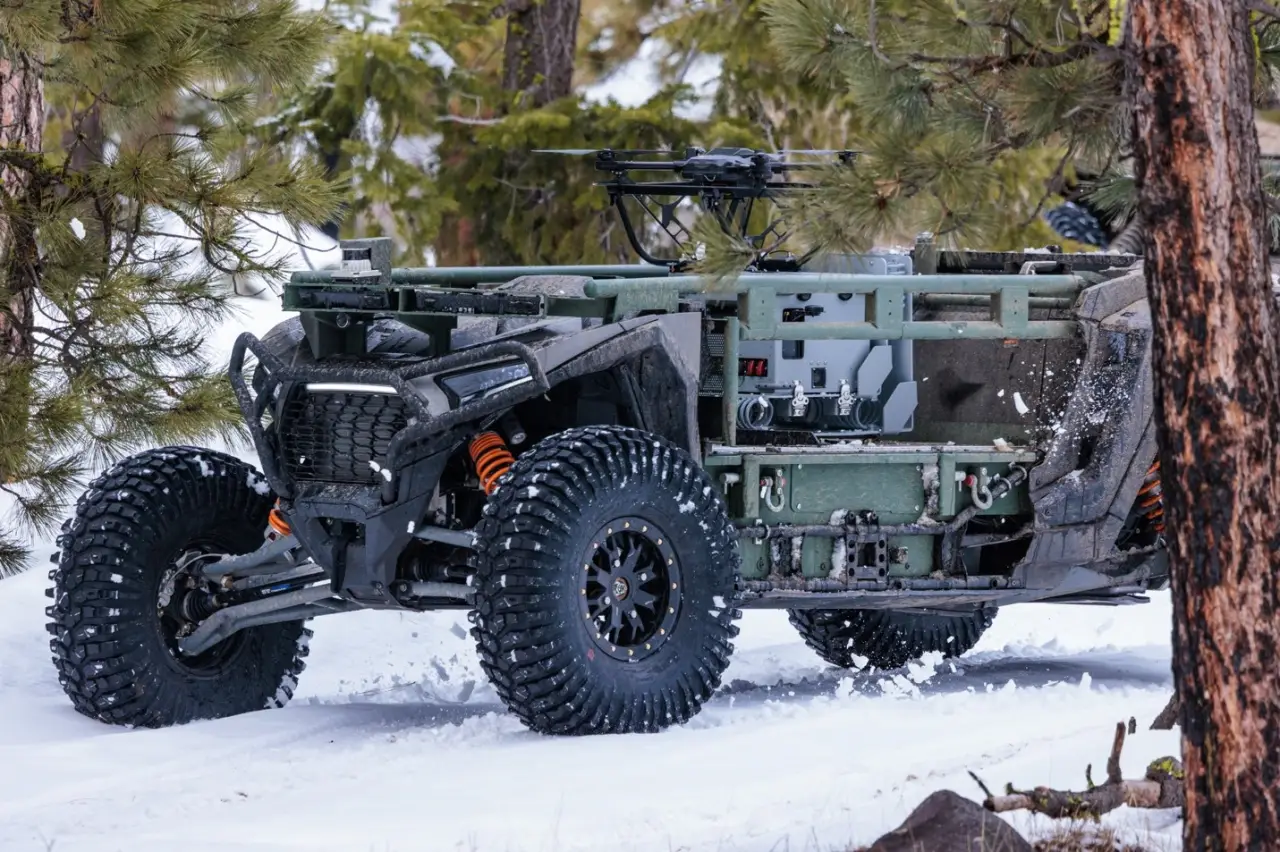
On July 29, 2025, the U.S. Department of Defense announced that soldiers from the 1st Squadron, 91st Cavalry Regiment of the 173rd Airborne Brigade conducted a successful live test of the ULTRA autonomous tactical vehicle during Exercise Agile Spirit 25 at the NATO-Georgia Joint Training and Evaluation Center in Krtsanisi, Georgia.
Developed by Overland AI, a defense tech company based in Seattle, the ULTRA (Uncrewed Long-range Transport Autonomy) platform is engineered to operate in high-threat environments without human input. Designed for autonomous logistics, it enhances the U.S. Army’s ability to conduct resupply missions without putting soldiers at risk.
ULTRA integrates Overland AI’s OverDrive autonomy software with a rugged military-grade chassis. Its advanced navigation system includes stereo vision cameras, LiDAR sensors, inertial measurement units, thermal imagers, and localization tools that function even when GPS is unavailable. This allows ULTRA to autonomously navigate complex terrain, avoid obstacles, and reroute in real time without relying on satellite connectivity.
During the Agile Spirit 25 exercise, ULTRA performed several missions across rough and wooded terrain, including cargo delivery, autonomous convoying, and off-road maneuvering. Soldiers praised its responsiveness to route changes and its effectiveness in minimizing exposure to battlefield threats like IEDs and ambushes.
This field test reflects a larger shift in the U.S. Army’s logistics approach—one that leverages robotics and automation to sustain combat operations more safely and efficiently. Similar technologies such as the Leader-Follower convoy system, robotic supply vehicles, and commercial platforms like GDLS MUTT and Polaris MRZR Alpha are being evaluated across test ranges including Fort Liberty and Yuma.
ULTRA features a modular payload bay that supports various mission types, from casualty evacuation to sensor deployment. It can carry up to 1,000 pounds (454 kg) of cargo, operate with either electric or hybrid propulsion, and sustain missions for over eight hours, depending on load and terrain. Cyber-secure processors and mesh networking allow seamless coordination with military command systems.
With continued testing scheduled through late 2025 and early 2026, ULTRA is positioned to become a key component of the U.S. Army’s uncrewed logistics framework—supporting operations across expansive and communication-challenged battlefields.
