

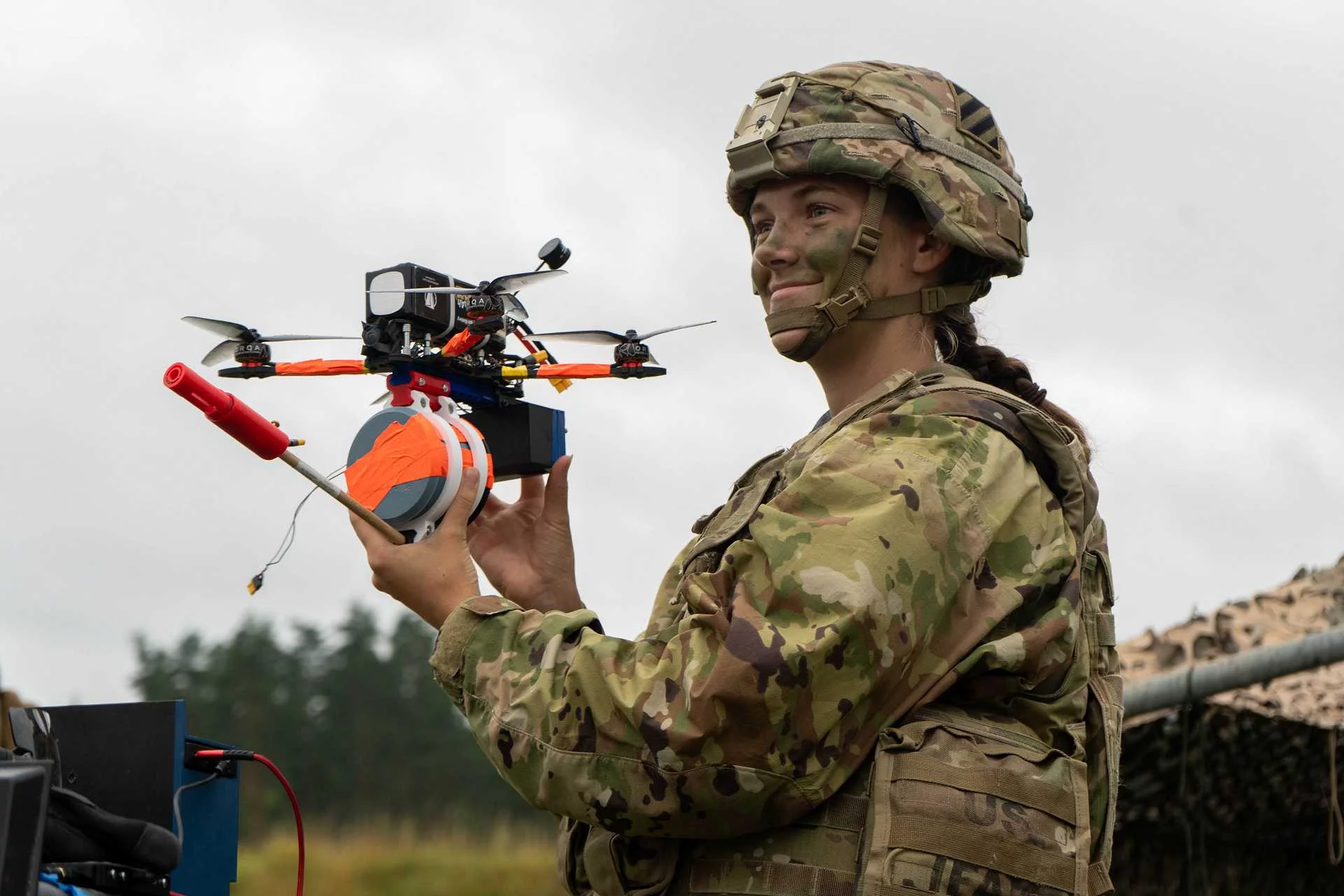
According to information published by the U.S. Department of Defense on July 22, 2025, the U.S. Army has begun live-fire field trials of armed First Person View (FPV) drones in the forests of Germany. These trials are being conducted by soldiers of the 3rd Infantry Division as part of the Army’s Transformation in Contact (TiC) modernization efforts. The low-cost FPV drones, capable of striking both moving and stationary targets, represent a significant evolution toward decentralized, drone-enabled lethality at the tactical level.
The use of armed FPV drones by the U.S. Army marks the first operational application of Purpose Built Attritable Systems (PBAS). These systems are designed to carry both lethal and non-lethal payloads at an affordable cost and with tactical portability. Each PBAS drone package includes FPV goggles, a controller, a display unit, and a mix of 10-inch and 5-inch air vehicles, with an approximate unit cost of $5,000. The live drone missions in Germany aim to validate PBAS effectiveness in wet, forested terrain and to refine operational drone tactics as part of TiC 2.0 experiments.
An FPV drone is a small unmanned aerial vehicle controlled remotely by an operator who uses a head-mounted display or goggles to receive a live video feed from the drone’s forward-facing camera. This setup gives the pilot a real-time, first-person view as if inside the drone, allowing precise maneuvering and target acquisition in complex and confined environments. Unlike traditional autonomous or pre-programmed drones, FPV drones are manually flown, providing unmatched control for close-range strikes, reconnaissance, and support missions. They can also carry munitions to execute high-precision surprise attacks on enemy positions.
FPV drones can be equipped with various payloads depending on mission requirements and target types. Lethal payloads may include anti-armor shaped charges, high-explosive fragmentation warheads, or improvised explosive devices capable of neutralizing light vehicles, defensive positions, or enemy personnel. Non-lethal configurations can carry electronic warfare modules, smoke canisters, flashbangs, or chemical irritants for crowd control or disruption missions. This versatile payload capacity makes FPV drones suitable for a wide range of tactical applications, including direct attacks on armored or soft-skinned vehicles, suppression of enemy air defenses, clearing trench lines, breaching fortified positions, or disabling infrastructure like radar arrays or command posts.
FPV drones are especially effective when providing close support to ground forces, who need immediate and precise firepower to overcome fortified enemy positions or repel counterattacks. Their small size and agility make them difficult to detect and engage by traditional air defense systems. Additionally, their first-person navigation capability allows operators to conduct precision strikes in complex and dynamic environments such as urban combat zones, forested areas, and mountainous terrain. FPV drones also enhance special operations by enabling silent, low-signature attacks behind enemy lines without risking personnel.
The U.S. Army’s adoption of FPV drones at the tactical level is directly influenced by battlefield innovations observed in the ongoing Russia-Ukraine conflict. Since early 2022, both sides have used low-cost FPV drones for direct strike missions. Ukraine, in particular, pioneered the widespread use of FPV drones configured as loitering munitions to accurately attack armored vehicles, artillery positions, and infantry while minimizing logistical burdens. Often based on modified commercial platforms, these drones demonstrated how small, agile, and manually piloted systems can bypass traditional defenses and reshape land warfare.
In modern combat, FPV drones offer advantages through their small size and high maneuverability, allowing operations in urban, forested, or cluttered environments inaccessible to larger UAVs. Equipped with explosive payloads or reconnaissance modules, they can function as precision-guided munitions or real-time surveillance tools, depending on mission needs. Their first-person view system enables operators to engage mobile or partially concealed targets with high accuracy.
Moreover, FPV drones support distributed and decentralized warfare by empowering small units to independently engage enemy assets, reducing reliance on larger, more vulnerable systems such as artillery or manned vehicles. Their low cost and expendable nature make them ideal for saturation attacks, diversionary tactics, and high-risk strikes on critical targets. Being lightweight, modular, and easy to transport, store, and deploy under battlefield conditions also offers significant logistical benefits.
As the U.S. Army continues integrating PBAS and FPV drones into its combat units, the insights gained from these early tests will shape future doctrine and procurement. The goal is clear: to deliver affordable, precise, and adaptable drone capabilities directly to the edge of the battlefield, equipping soldiers with cutting-edge tools to dominate across all domains.
