

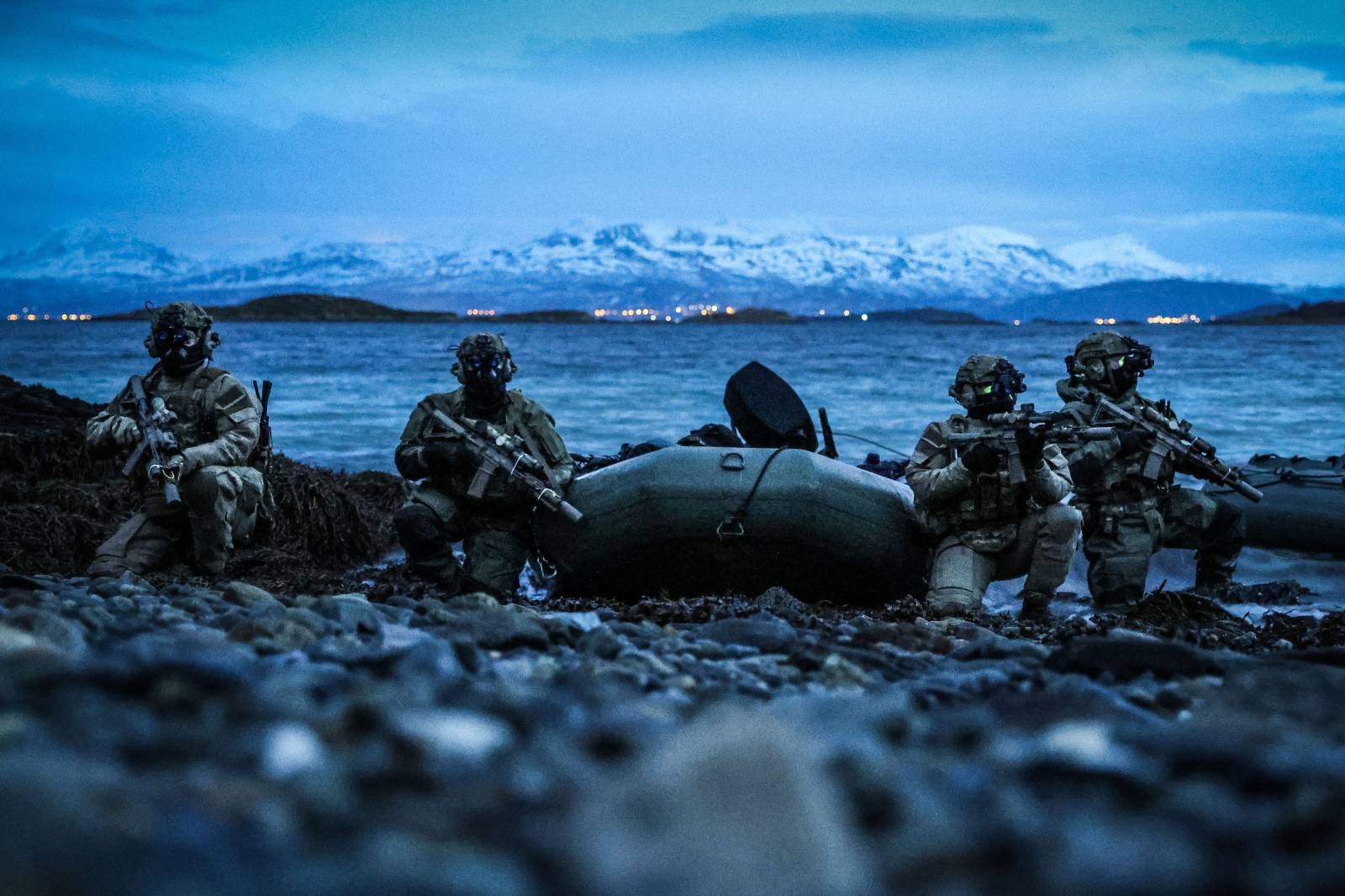
The United Kingdom has pushed its newly formed Special Operations Maritime Task Group (SOMTG) into the closing stages of operational preparation after a series of discreet boarding exercises in the eastern Baltic and a combined ship-to-shore raid on Estonia’s Saaremaa Island. Built around Royal Marine detachments from 42 and 47 Commando and embarked aboard the Royal Fleet Auxiliary vessel RFA Lyme Bay, the unit practised rapid interdiction, coastal strike and linkage with land special forces to create a fast, flexible maritime counter-threat capability.
Across October and early November, teams rehearsed high-tempo insertions — including fast-rope descents, small-boat approaches and coordinated intelligence-led shore assaults — in concert with the British Army’s 3rd Ranger Battalion. Organised as a roughly 150-person, mission-tailorable package, the SOMTG brings together boarding teams, rotary and small-boat crews, engineers and support specialists so a single maritime spearhead can seize back a captured vessel, secure an offshore installation or clear a littoral objective to enable follow-on amphibious operations.
The concept’s strength lies in platform agnosticism: by operating from an auxiliary logistics ship, commandos can project reach and endurance while preserving the option to launch clandestine approaches from Commando boat flotillas for shallow-water work. That model is designed to complicate adversary plans in the congested and politically sensitive waters of Northern Europe, where vital energy nodes and subsea infrastructure present lucrative hybrid targets.
Planners stress, however, that credibility depends on a suite of enablers. Persistent intelligence, surveillance and reconnaissance to cue time-sensitive boardings, hardened command links resilient to GPS and electronic attack, counter-uncrewed systems and clear legal authorities for visit, board, search and seizure in international and crowded seas are all required to operate at pace and scale. Platform agnosticism increases tempo but also raises sustainment demands — from RFA availability to small-boat maintenance and cold-weather readiness.
The SOMTG’s preparations dovetail with wider allied activity, including the Joint Expeditionary Force’s large-scale exercise Tarassis across Norway, Latvia, Finland and the eastern Baltic. The UK is targeting a formal evaluation early next year and a validation window from June 2026, which — if achieved — would give NATO a discrete, rapid maritime option to reverse hybrid grabs and protect critical maritime infrastructure without immediately committing major amphibious formations.
