

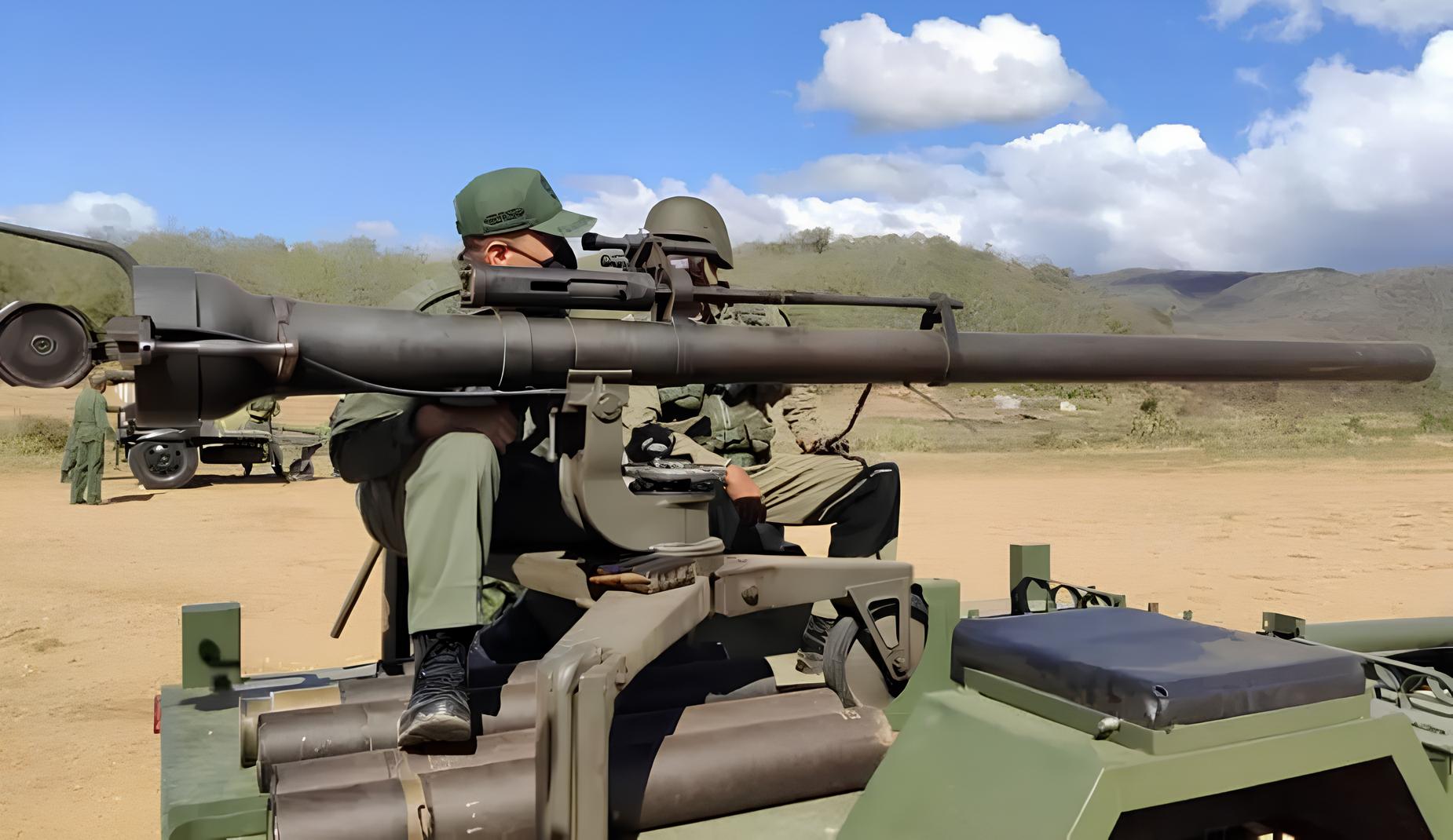
The Venezuelan Army has publicly showcased its renewed emphasis on anti-armor warfare, releasing images and footage from a large-scale exercise featuring 106 mm M40A1 recoilless rifles. Conducted on 9 November 2025, the drills displayed vehicle-mounted systems engaging simulated armored targets, highlighting both crew proficiency and the continued reliance on legacy yet practical anti-tank platforms.
Published through the Army’s official communication channels, the event appeared designed not only to test operational readiness but also to project confidence amid persistent regional tension. The visual presentation — disciplined firing sequences, controlled movement of vehicles, and detailed technical commentary — conveyed that the training had a strategic purpose: reassuring domestic audiences of the military’s preparedness while signaling to external actors that Venezuela maintains credible territorial defense options.
Legacy System, Modern Relevance
The M40A1 recoilless gun, a U.S.-designed system first fielded in the mid-20th century, remains in service across several militaries due to its mechanical simplicity and battlefield reliability. Venezuelan forces employ the weapon primarily in vehicle-mounted configurations, allowing small teams to conduct rapid “shoot-and-scoot” maneuvers. In the released footage, operators were seen executing quick emplacement, firing and relocation drills — a tactic well suited for terrain-based ambushes and mobile defense.
Technically, the 106 mm M40A1 uses a venturi-based recoilless design that expels gases rearward, neutralizing most recoil and permitting light mounting on soft-skinned vehicles. Fitted with optical day sights and compatible with clip-on thermal modules, the gun is capable of direct fire using HEAT (High-Explosive Anti-Tank) rounds. The ammunition observed in the drill appears consistent with modern HEAT designs, possibly sourced from Israel Military Industries, though origin remains unconfirmed.
Practical Benefits and Limitations
Despite its age, the M40A1 offers a number of advantages in resource-constrained defense environments: low unit cost, short training cycles, and minimal maintenance requirements. These traits enable broad distribution among territorial defense formations, offering a cost-effective deterrent against armored incursions. However, its limitations are well recognized — short effective range, limited precision compared to guided missiles, and reduced lethality against modern reactive or composite armor. Crew exposure during firing, due to the weapon’s backblast and line-of-sight engagement, also remains a tactical challenge.
Strategic Messaging
The Venezuelan Army’s decision to publicize the drills carries clear political and military messaging. Operationally, it underscores a doctrine of localized, flexible defense built on mobility and layered deterrence. Politically, it amplifies national resilience by showcasing readiness without the need for high-end imported weaponry. By integrating a U.S.-origin platform with potentially Israeli-made munitions, the exercise also highlights pragmatic adaptation — extending the service life of existing systems through hybrid sustainment rather than replacement.
In essence, the event projects a clear narrative: readiness under constraint. Venezuela’s armed forces continue to rely on proven, maintainable systems to deter aggression, demonstrating that legacy hardware, when paired with trained crews and effective tactics, remains a credible component of national defense in an era of hybrid and asymmetric threats.
