

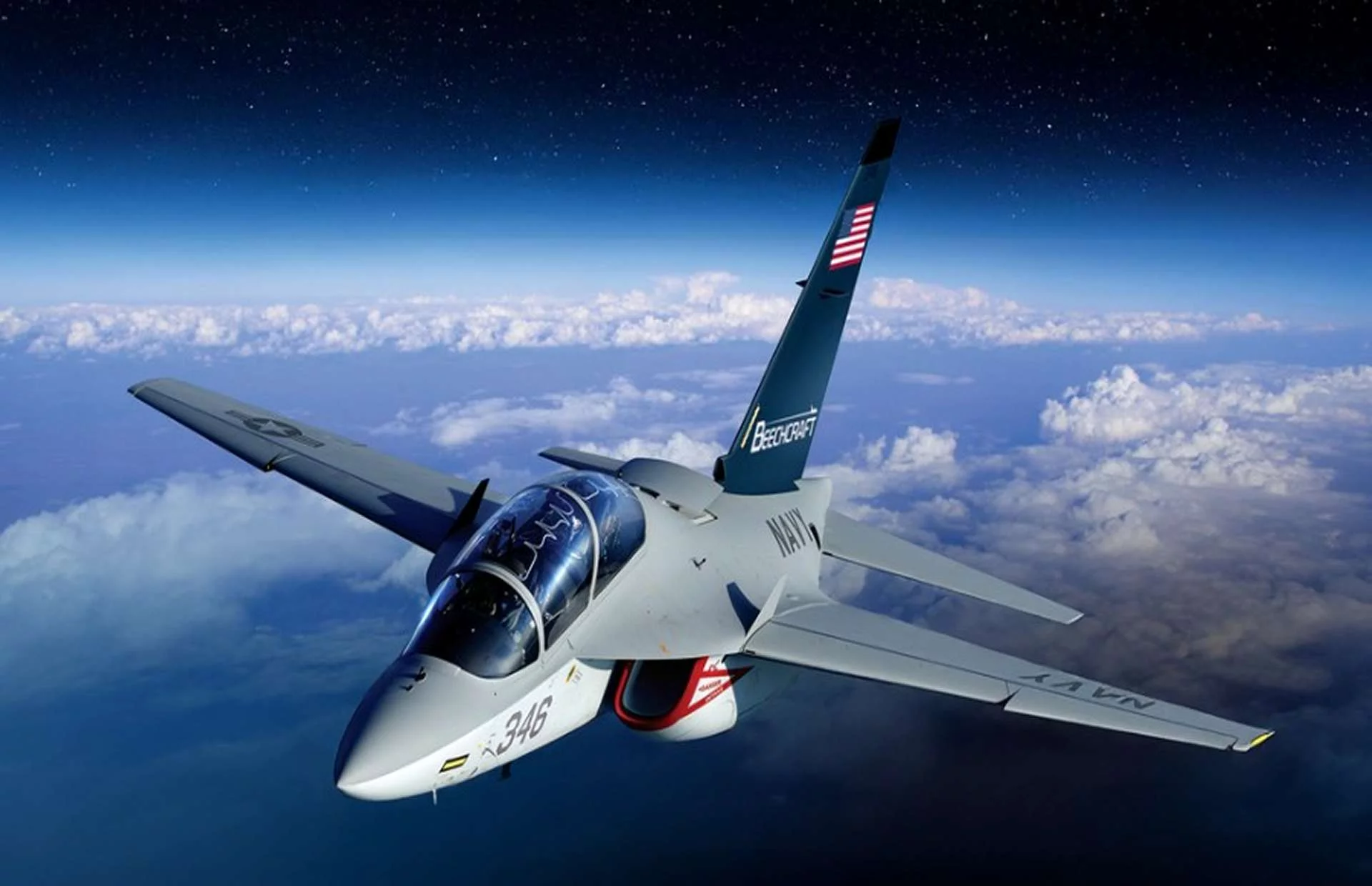
The U.S. Navy has issued a Request for Information (RFI) for the Undergraduate Jet Training System (UJTS) to replace the aging T-45 Goshawk on an accelerated timeline that prizes rapid initial operational capability and a digitally native training ecosystem. Four industry teams—Boeing–Saab, KAI–Lockheed Martin, Leonardo (with Textron), and Sierra Nevada Corporation—have entered the contest.
Key program milestones in the draft RFI include a December 2025 RFP, a target award in January 2027, a carrier-landing requirement limited to wave-off practice (not full deck qualifications), and a four-tier ground training architecture that tightly networks live jets, operational flight trainers, unit devices, and desktop trainers for large-scale LVC (live-virtual-constructive) events.
Contenders at a glance:
- Boeing–Saab (T-7A Red Hawk): A digitally born platform with a strong production and training ecosystem, modern glass cockpit, and proven digital-engineering pipeline. It offers scale and a rich upgrade path, though adapting an Air Force-optimized design to naval corrosion, pattern work, and maritime ops introduces schedule and integration risk.
- Leonardo M-346N: A twin-engine, high-angle-of-attack trainer with an existing global user base and mature LVC hooks. Twin engines offer redundancy and safety for repetitive pattern work over water, mapping well to CNATRA’s intensive syllabus—albeit at a potential cost and logistics premium.
- KAI–Lockheed (T-50N / TF-50N): A supersonic, high-energy family with proven operational pedigree and radar/weapon derivatives that let instructors teach authentic intercept and sensor timelines. Naval adaptation and saltwater durability would require focused demonstration and modification.
- Sierra Nevada (Freedom Trainer): A clean-sheet, naval-first design emphasizing synchronized software loads across the fleet-and-simulator ecosystem, long life-cycle targets, and lower operating costs. Its strengths align with the RFI’s ground-based/LVC priorities, but certification speed and IOC deadlines are challenges.
CNATRA’s syllabus—heavy on instrument work, formation, BFM, intercepts, FCLP, and compressed sortie rhythms—forces a winner that is more than an airframe: the Navy wants a complete training system that moves students from academics through high-fidelity simulators to realistic, networked flying with minimal seams.
Tradeoffs are clear. The T-7A brings a large digital community and lifecycle scale; the T-50 family gives the most fighter-like energy picture; the M-346N blends handling fidelity with twin-engine safety; and Freedom offers a naval-optimized software stack from day one. Beyond performance, industrial policy, sustainment, and geopolitics matter: a U.S.-led design simplifies security and supply concerns; foreign airframes bring industrial partnerships and export ties that will shape Congress’s view.
Bottom line: the Navy is buying how students learn as much as what they fly. The competition rewards not just the best airplane on paper, but the platform whose ecosystem—simulators, networked training, sustainment, and upgrades—best prepares the next generation of carrier pilots.
