

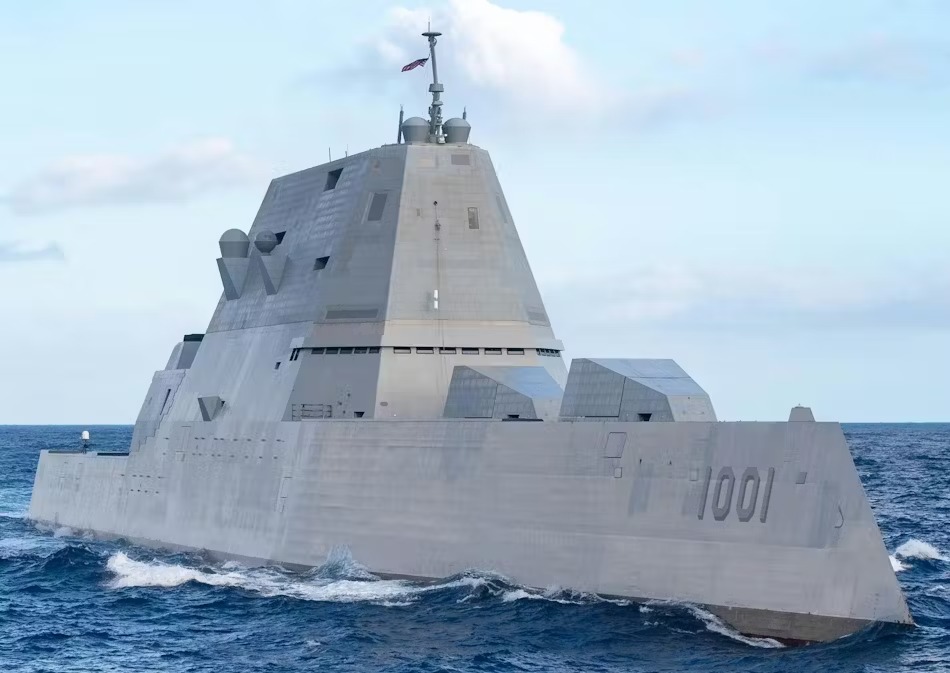
The Zumwalt-class destroyers are a trio of advanced multi-mission stealth warships operated by the United States Navy, primarily designed for land-attack missions. Conceived originally to replace battleships in providing naval gunfire support, these ships were built with a strong emphasis on stealth, featuring a low radar cross-section and a distinctive hull shape.
Design and Capabilities
At the heart of the Zumwalt-class design are two Advanced Gun Systems (AGS) equipped with unique Long Range Land Attack Projectile (LRLAP) ammunition, intended for precision naval gunfire support. However, cancellation of the LRLAP program left these guns without usable ammunition, forcing the Navy to pivot the ships’ mission focus towards surface warfare.
The vessels feature a wave-piercing tumblehome hull, where the sides slope inward above the waterline, a design choice that substantially reduces radar detectability compared to conventional warship hulls. This stealthy profile has drawn comparisons to historic ironclads like the USS Monitor.
Zumwalt ships utilize an integrated electric propulsion system capable of distributing power flexibly between propulsion, weapons, and onboard systems. The ships also incorporate advanced automation, including fire-fighting and piping rupture isolation, allowing for reduced crew sizes and operational costs relative to similar vessels.
Program History and Costs
Originally envisioned as a class of 32 ships with an estimated $9.6 billion in research and development, the Zumwalt program faced significant cost overruns and technical challenges. The planned number of vessels was gradually cut down to three, resulting in a per-ship cost soaring to approximately $4.24 billion (excluding R&D), which is substantially higher than many other major naval assets, including nuclear-powered submarines.
These escalating costs led to a breach of the Nunn–McCurdy Amendment, triggering cancellation of further production. By 2016, the overall program cost had reached $22.5 billion, with an average cost of about $7.5 billion per ship. Critical commentary, such as from National Review’s Mike Fredenburg, has described the Zumwalt-class program as a significant failure.
The lead ship, USS Zumwalt (DDG-1000), is named in honor of Admiral Elmo Zumwalt.
Legacy
While the Zumwalt-class has faced setbacks, its innovative technologies and stealth design have influenced modern naval engineering and shipbuilding. However, the Navy has largely reverted to expanding the proven Arleigh Burke-class destroyers for its surface combatant needs.
