

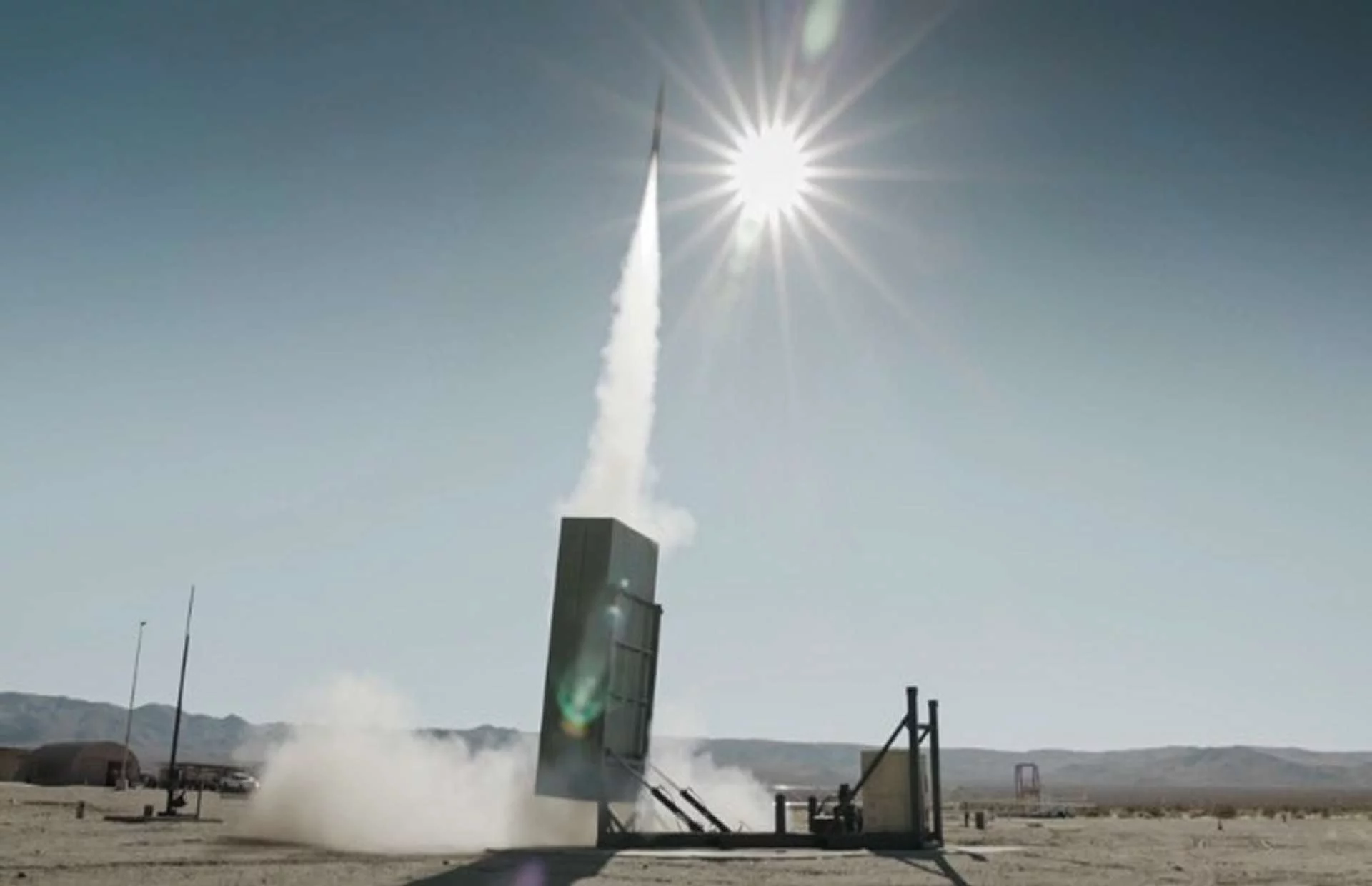
U.S.-based defense technology company Castelion announced that it has received new contracts from the U.S. Army and Navy to integrate its Blackbeard ground-launched hypersonic missile family onto land and naval platforms. The company stated that upcoming live-fire tests are intended to accelerate the system’s adoption. The program is structured as a two-phase Middle Tier Acquisition rapid prototyping effort aimed at developing low-cost, mass-producible hypersonic munitions and is designed to be compatible with HIMARS systems.
According to Castelion’s October 24, 2025 announcement, the Blackbeard program has already completed more than 20 test flights successfully, positioning it to move directly from integration to field testing.
Blackbeard: Affordable Hypersonic Strike Capability
Blackbeard is listed in the U.S. Army’s fiscal year 2026 budget as “HX3, All Up Round and Canister.” The missile is described as a seeker-guided, precision strike weapon capable of engaging both mobile and hardened targets. Its primary advantage is a significantly lower unit cost compared with existing hypersonic munitions.
In the near term, system integration will run through modified MLRS Family of Munitions pods and the M142 HIMARS fire control system, enabling the platform’s first live-fire demonstrations via HIMARS before dedicated launcher hardware is developed.
The program’s first phase begins with an air-launched flight test using a modified pod, followed by a HIMARS-launched minimum viable product test. If successful, the second phase will produce 10 production-representative rounds, integrated with both the M142 HIMARS and flight termination systems. Congress has allocated $25 million to execute this plan.
Complementing, Not Replacing, LRHW
Pentagon sources emphasize that Blackbeard is not intended to replace the Long Range Hypersonic Weapon (LRHW). The missile has shorter range and lower speeds than LRHW but aims to deliver roughly 80% of the future Precision Strike Missile (PrSM) Increment 4 capability at much lower cost. This positions Blackbeard as the low-cost element in a high-low mix for long-range fires.
The program is expected to eventually integrate with the Common Autonomous Multi Domain Launcher (CAMDL), with HIMARS serving as an interim launch platform for rapid fielding.
A New Phase in the Hypersonic Race
Blackbeard is designed to provide Army fires brigades with a mobile, survivable hypersonic missile system capable of rapid repositioning. Integrated with joint ISR cueing, the seeker-guided round can target mobile land systems, naval units, and air defense assets.
For the Navy, Castelion’s contracts indicate a parallel integration path for maritime platforms. Previous work with the U.S. Office of Naval Research (ONR) on air-launched anti-surface weapons could support Blackbeard’s future naval variants.
A Milestone in U.S. Hypersonic Strategy
As the global hypersonic competition intensifies, the Blackbeard program aims to provide the U.S. with scalable hypersonic capabilities without relying solely on high-cost systems. According to Reuters, Pentagon support for the project is part of a broader effort to translate hypersonic technology into deployable combat power and enhance deterrence in a cost-effective manner.
If Blackbeard’s testing and production pace meets expectations, the program will provide the U.S. with both high-speed maneuverability and expanded hypersonic munitions stockpiles, allowing Washington to shift from a “few expensive” strategy to a “many and effective” hypersonic force architecture.
