

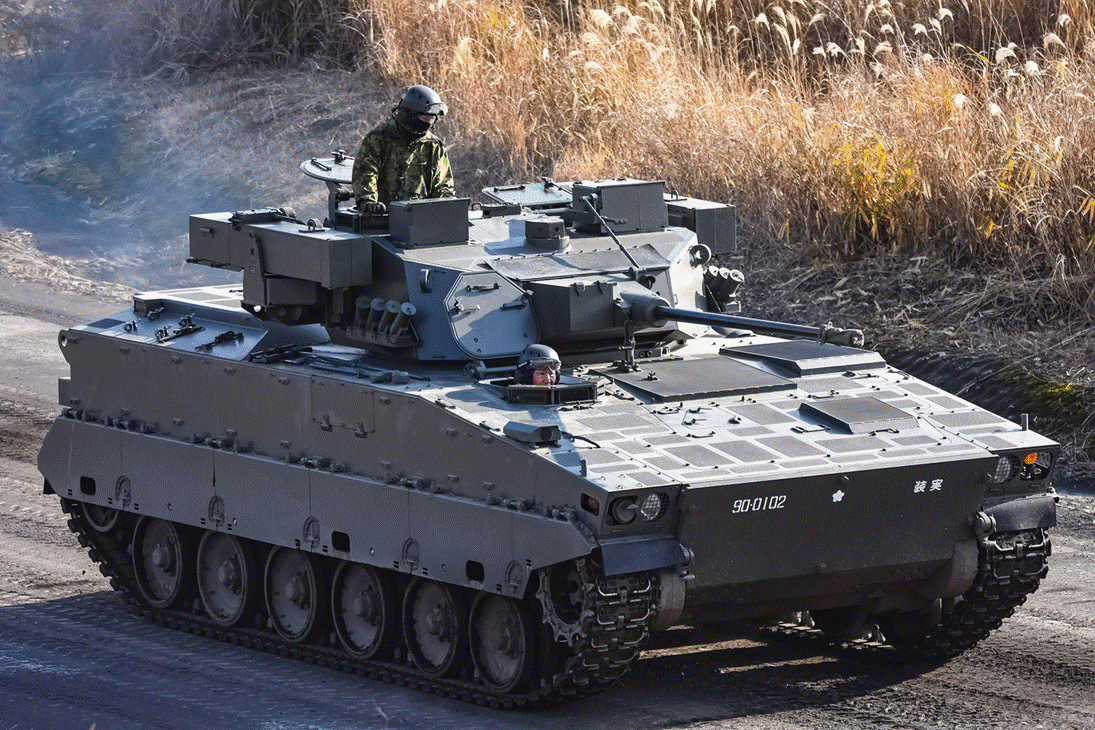
According to program documents circulated on X, Japan’s Ministry of Defense is evaluating counter-UAS self-protection for its Common Platform Tracked (CPT) family. Two primary variants a 35-ton IFV and a 33-ton APC would mount four MESA radar panels around the turret to provide continuous 360-degree detection and cueing for onboard weapons systems.
Turret and Armament: Tailored for Rapid Engagements
The IFV variant retains a remote turret concept and the 30 mm Mk44 Bushmaster as its main armament, with employment concepts highlighting airburst-capable rounds (preset detonation) to defeat small multirotors in cluttered environments. The APC variant uses the M230LF integrated on an RS6 remote weapon station, leveraging radio-fuzed 30×113 mm rounds that fragment targets in the munition’s flight envelope without prolonged bursts.
Four-Face MESA Network: Removing Blind Arcs
Fitting four compact MESA panels to turret faces creates a continuous local recognized air picture. Ku-band cognitive MESA radars — compatible with cited performance envelopes (broad field of view, high update rate, low power draw, and high bandwidth outputs) — enable robust tracking on the move and maintain capability under EMCON. The multi-face approach eliminates blind arcs common to single-aperture C-UAS kits.
Layered Defense and APS Potential
The architecture shifts detection, tracking, cueing and kinetic defeat onto the vehicle itself, reducing reliance on separate short-range air defense batteries. If power, I/O and latency margins are preserved, the MESA network can support both millisecond-scale APS hard-kill engagements and longer-range MALE UAV tracking — compressing the sensor stack and simplifying battalion-level COP inputs.
Tactical Effects: Momentum, Protection, and Tempo
Operationally, integrated turret sensors change unit behavior: short-range UAVs no longer force columns to halt for external suppression. Gunners receive automatic engagement solutions and recommended bursts; airburst settings plug gaps where conventional HE-T is less effective. Units maintain EMCON, emitting only when necessary, preserving survivability against adversary EW and artillery cueing.
Strategic Implications: Fieldable Survivability at Scale
In the Indo-Pacific, where littoral and urban fights impose short reaction windows, vehicles that locally generate a credible air picture and share a minimal COP complicate adversary ISR and attack planning. Open-architecture development would allow joint air-defense integration while preserving autonomy if links degrade — offering practical survivability that armies can realistically field in quantity.
