

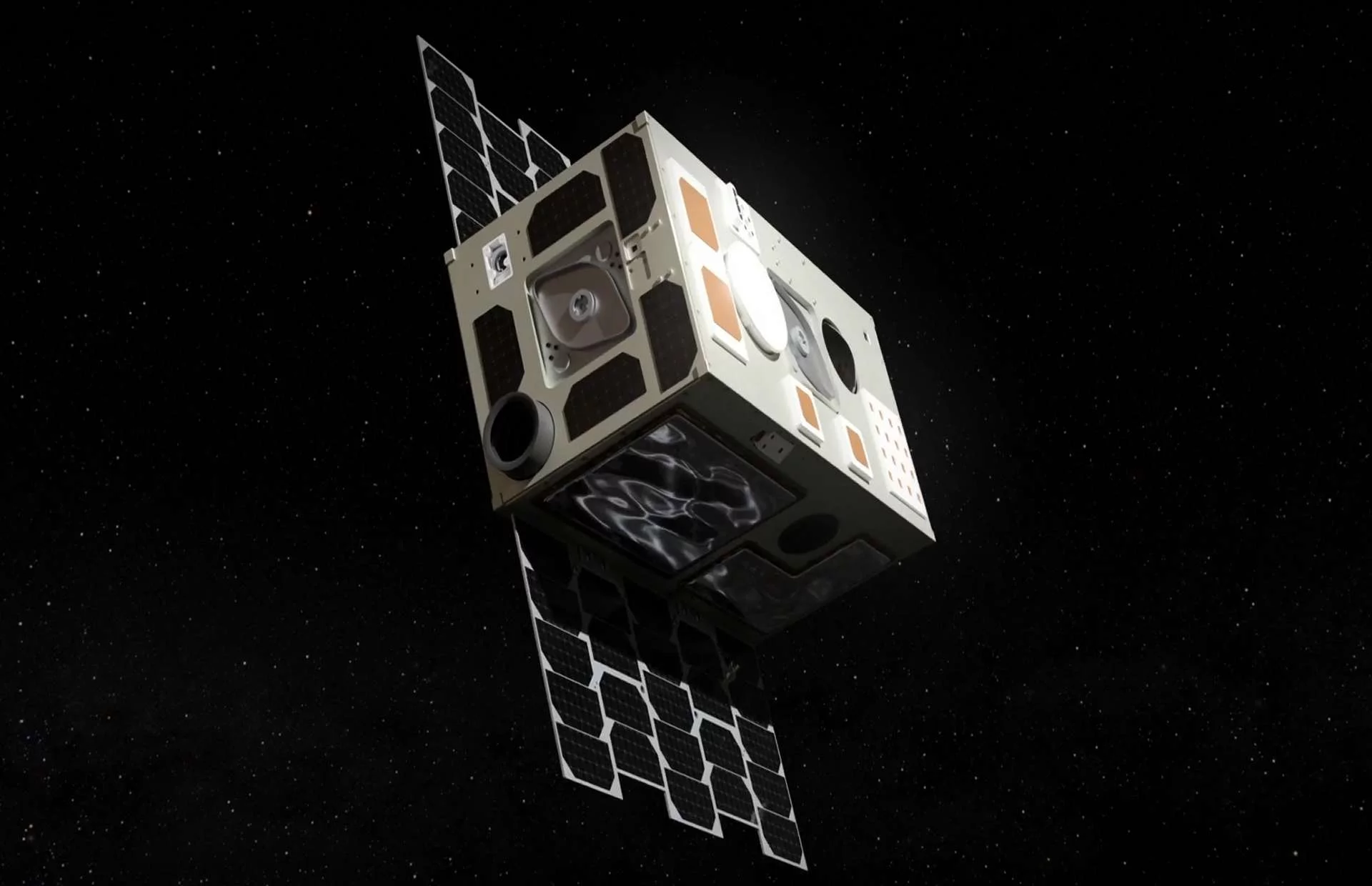
The French Ministry of Armed Forces has awarded New Space firm Infinite Orbits a framework agreement worth up to €50 million for the development of the PALADIN (Positioning and Autonomous Laser Assisted Detection in Near-space) satellite under the national Action and Resilience in Space (ARES) program. Announced on August 11, 2025, the contract tasks Infinite Orbits with delivering a geostationary inspection and surveillance capability to the French Space Command (CDE), with launch scheduled for 2027. The project builds on the company’s existing Orbit Guard platform and is supported by funding from the France 2030 investment plan coordinated by CNES.
PALADIN is a compact yet highly capable orbital guardian, designed to patrol the geostationary belt, identify satellites in proximity, and conduct detailed inspections using advanced optical sensors, autonomous navigation, and electric propulsion. It will be able to perform both wide-area surveillance and targeted close approaches, providing high-resolution imagery for defensive monitoring and preparatory space operations.
For France, PALADIN represents a strategic leap in securing national sovereignty in space. GEO hosts vital military assets, including communications, meteorological, and intelligence satellites. In an increasingly congested and contested orbital environment, PALADIN will enable France to detect, verify, and respond to anomalous or hostile actions without relying solely on allied intelligence, ensuring the CDE can act independently in defense of critical infrastructure.
The satellite inherits proven capabilities from Infinite Orbits’ Orbit Guard series, such as vision-based rendezvous, centimeter-level pose estimation, debris detection, trajectory tracking, and precise maneuver planning. Its electric propulsion system will enable efficient station-keeping and rapid relocation across GEO, while AI-driven control algorithms optimize inspection geometry and hazard avoidance. Ground-based optical tracking networks will further refine its operations.
Equipped with multispectral optical sensors offering sub-meter resolution, PALADIN will be capable of identifying fine structural details on target spacecraft. Onboard high-speed processing will support real-time image analysis and classification, while encrypted communications will secure data transfer to the CDE. AI-assisted decision-making will allow the platform to autonomously execute preplanned response maneuvers against potential threats.
Awarded in under three months, the PALADIN contract signals France’s determination to rapidly integrate innovative SME-driven solutions into its defense architecture. The program is also a precursor to EGIDE, the nation’s future military space engagement system planned for 2030. Once operational, PALADIN will place France among the few nations with autonomous GEO defense capabilities, reinforcing resilience against emerging threats in the increasingly contested space domain.
