

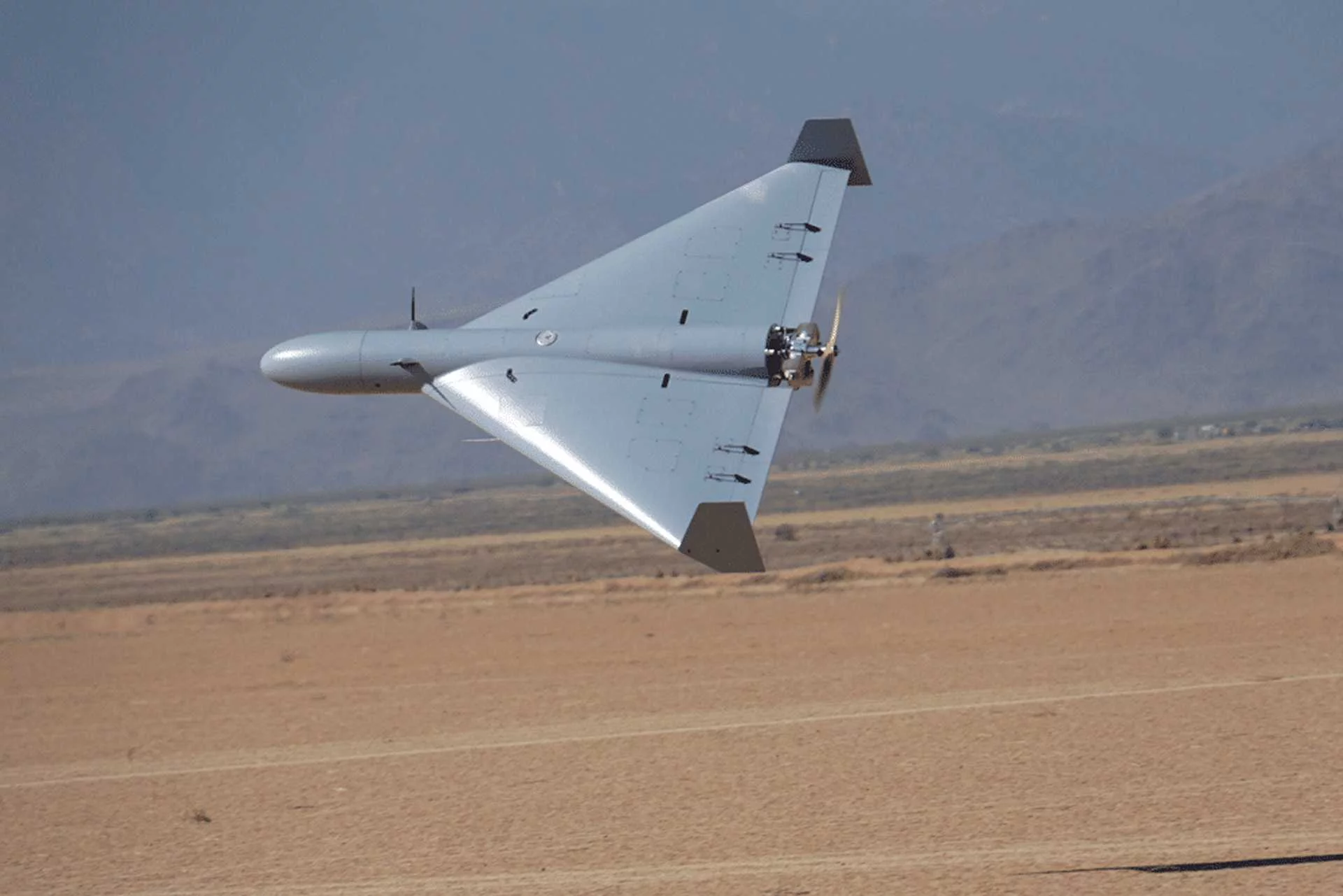
The United States officially introduced the LUCAS (Low-Cost Uncrewed Combat Attack System), a new loitering munition developed by Arizona-based defense contractor SpektreWorks, designed as an affordable and functional counterpart to Iran’s widely deployed Shahed-136 drone. The unveiling took place in the Pentagon courtyard alongside 18 other autonomous systems.
Defense Secretary Pete Hegseth personally reviewed LUCAS during the event, highlighting the Pentagon’s broader strategy to equip U.S. and allied forces with scalable, attritable unmanned systems for dispersed operations, especially in the Indo-Pacific theater. LUCAS has passed successful tests and is slated for near-future deployment.
Evidence suggests LUCAS is derived from or closely related to the FLM 136 target drone—often mistakenly referred to as FLM 131. SpektreWorks’ website details FLM 136 with size, configuration, and mission profiles matching LUCAS. SpektreWorks was selected for the Army’s APFIT (Applied Small UAS Prototype Innovation Transition) program focused on accelerating low-cost, modular drone systems into service. The announcement included video footage of FLM 136 launches.
LUCAS features an open architecture supporting modular payload bays accommodating reconnaissance sensors, EW modules, or explosives. It operates on 28V and 12V power and enables in-flight payload switching. Launch options include truck-based deployment and Rocket-Assisted Take-Off (RATO), eliminating need for specialized infrastructure or crews.
Classified as a Group 3 UAV, FLM 136 weighs up to 600 kg and can operate at altitudes up to 5,500 meters. Visually, it resembles Iran’s Shahed-136 with a triangular wingspan of 2.5–3 meters and a piston engine. However, LUCAS adds modularity allowing partial reuse and integrates with the MUSIC (Multi-domain Unmanned Systems Communications) network for swarm coordination and communications relay. Its launch weight is about 70–100 kg.
LUCAS emerged under the July 10, 2025, U.S. policy initiative titled “Unleashing U.S. Military Drone Dominance”, aimed at accelerating drone procurement, lowering regulatory barriers, and scaling production of expendable systems. Group 1 and 2 drones were reclassified as “consumer goods” or “expendables” akin to munitions like grenades, enabling easier procurement. Although LUCAS falls under Group 3, similar reforms expedite its deployment. Unit-level commanders now have direct procurement authority, bypassing traditional acquisition.
This policy shift is backed by new funding and structural reforms such as institutionalizing the Rapid Defense Experimentation Reserve (RDER) and integrating live-fire Technology Readiness Experimentation (T-REX) twice yearly. Drones including LUCAS reached readiness in as little as 18 months compared to typical six-year cycles.
Simultaneously, the U.S. Department of Commerce initiated a Section 232 national security probe into drone and component imports, targeting Chinese firms like DJI and Autel Robotics. The investigation aims to reduce foreign dependency and boost domestic drone production, dovetailing with “Buy American” and FAA’s accelerated certification efforts.
Iran’s Shahed-136 drone revolutionized asymmetric warfare due to its low cost, 2,500 km range, and single-use explosive payload. Widely deployed in Ukraine and Middle East, it’s used by Russia as Geran-2 to saturate defenses. Its simplicity and use of commercial components have inspired global imitators.
LUCAS is not merely a copy but a network-enabled, modular, and potentially reusable system integrated into U.S. combat doctrine—representing both a technological and doctrinal response to the growing global proliferation of loitering munitions.
